
Last updated October 16, 2026
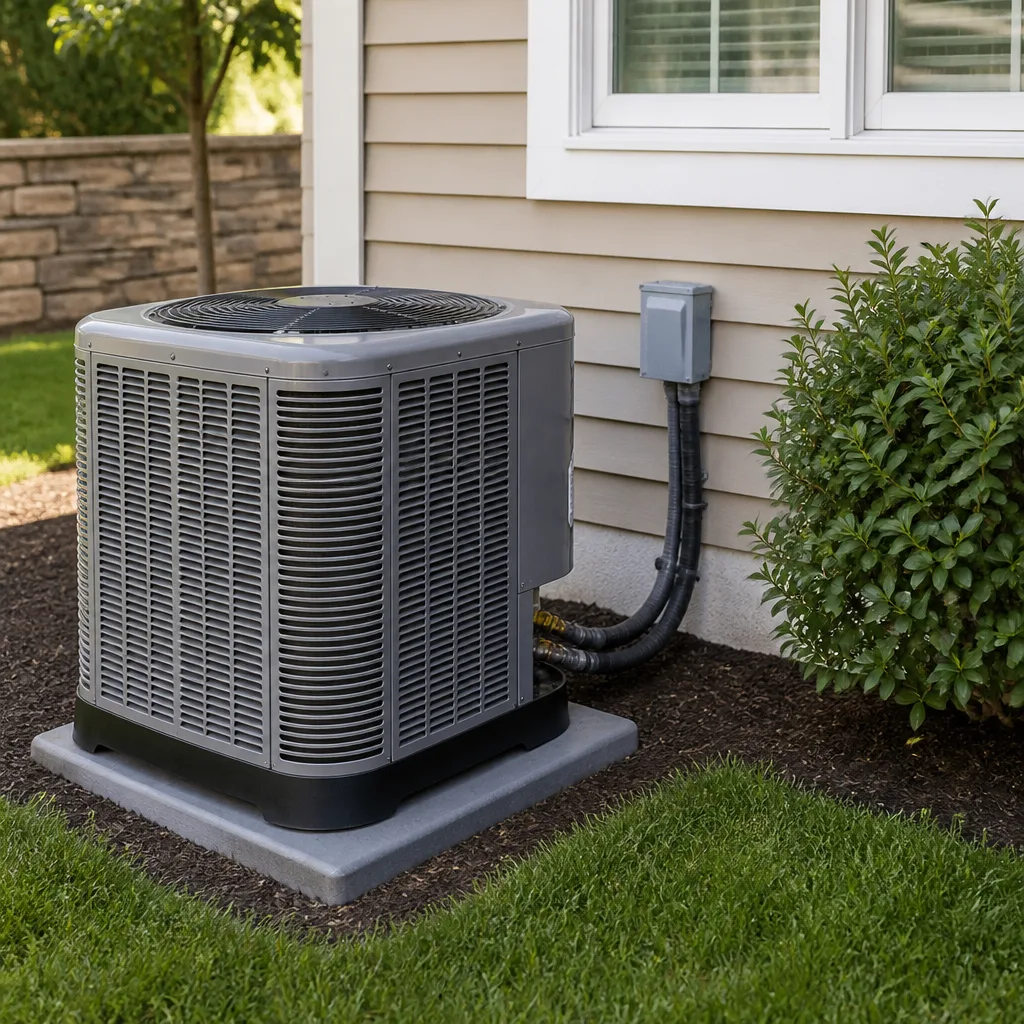 AC repair
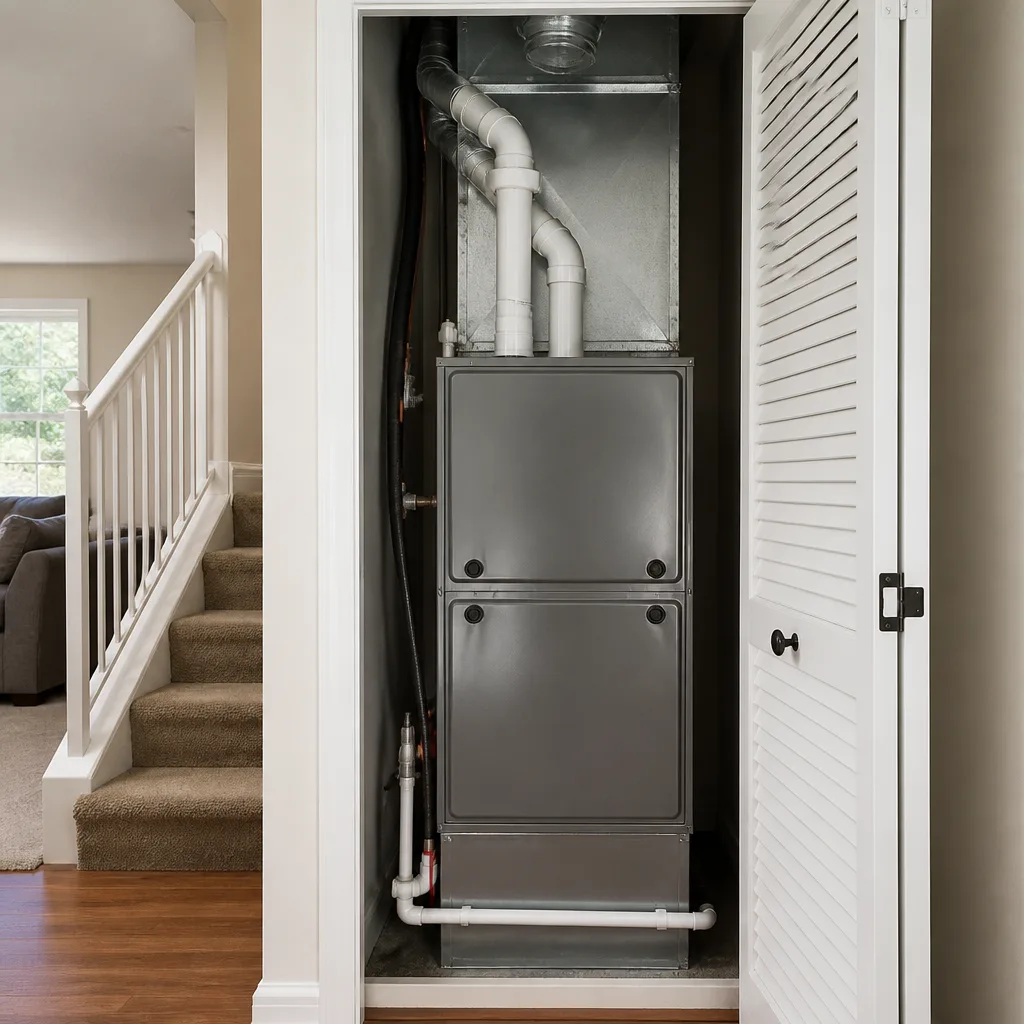 Furnace & heating
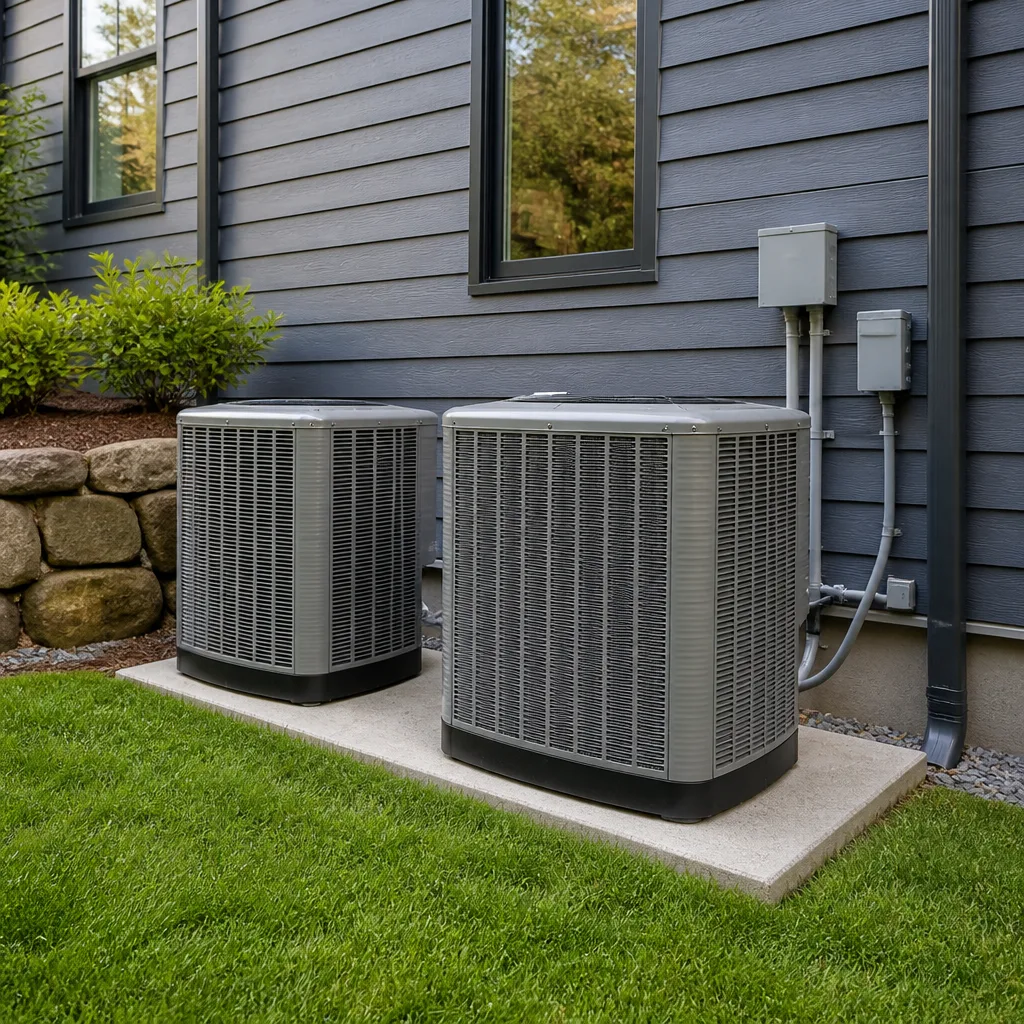 Heat pumps
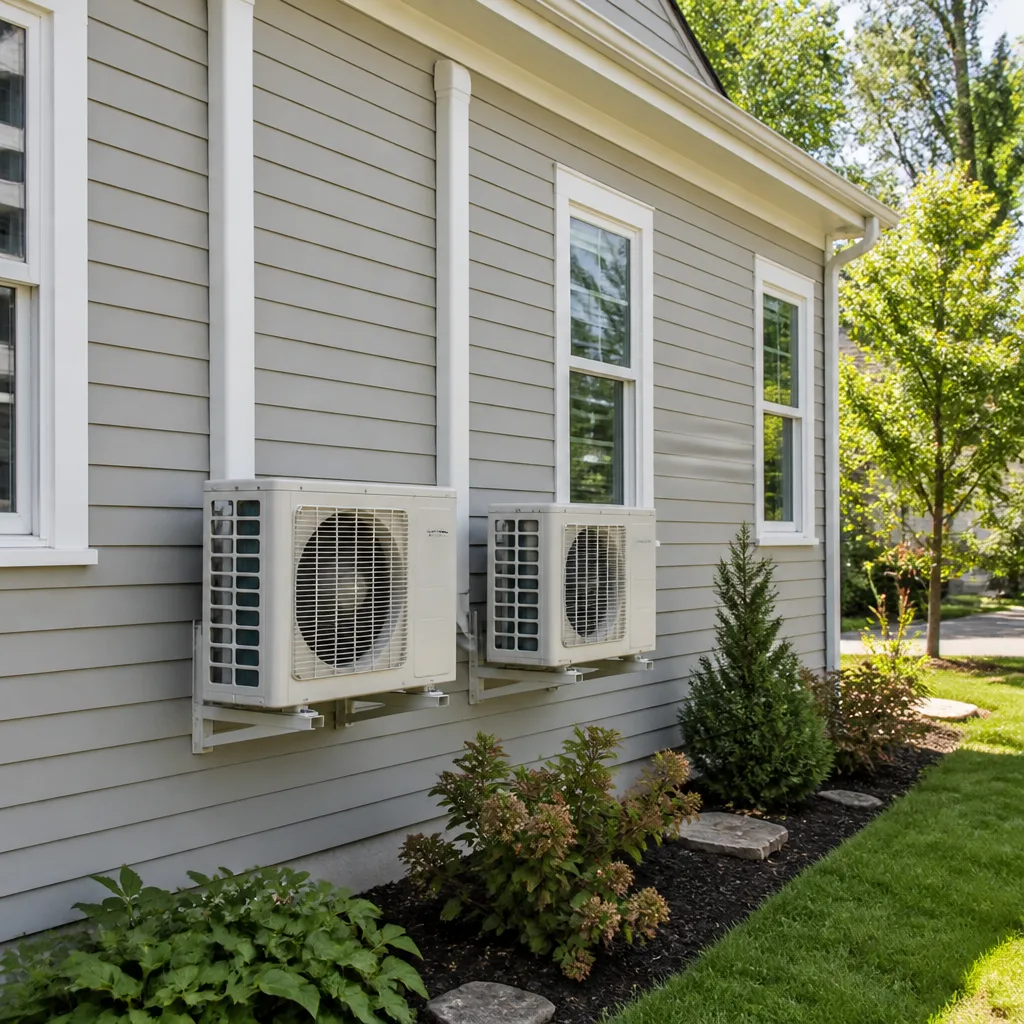 Ductless mini splits
 Carrier
 Trane
Trane Goodman
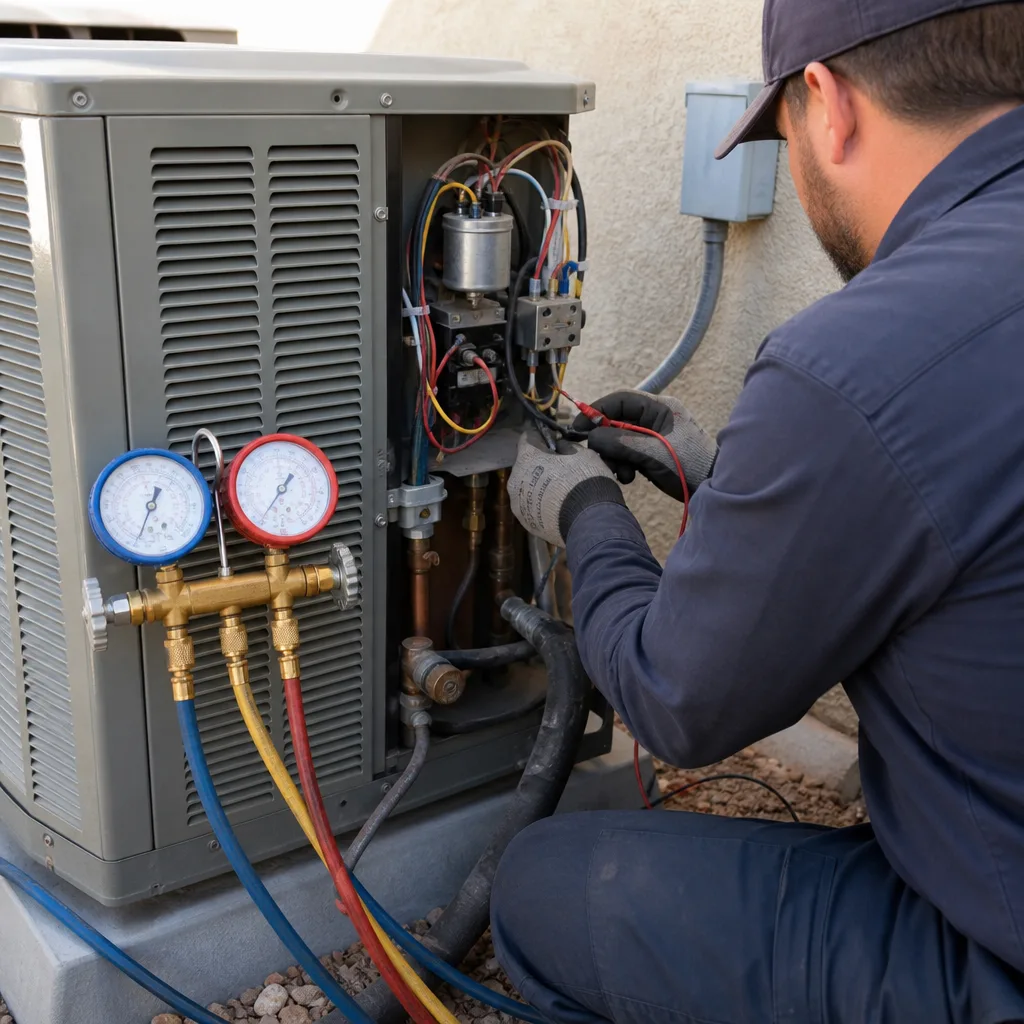
Seasonal tune-up and full diagnostic on your Carrier, Trane, or Goodman system - readings shown to you before any repair is proposed
Diagnosis first, numbers second - you approve the repair price before a single part goes in.
Get your free estimateDIY vs Professional HVAC: The Henderson Homeowner’s Decision Guide
Replacing your own air filter is DIY. Topping off your own refrigerant is a federal Section 608 violation with fines up to $44,539 per day. Between those two tasks is a clear line most Henderson homeowners have never been shown, and YouTube tutorials don’t bother to mention it. This guide draws that line precisely, task by task, using the actual warranty language from Carrier, Trane, and Lennox, the Nevada licensing rules that apply in Clark County, and the real cost cascade that happens when a $14 fix gets ignored in the Henderson heat. If you’ve ever stood in the garage holding a multimeter and wondering whether this is a Saturday project or a licensed trade, this is the answer.
Quick Answer
In Henderson, homeowners can legally and safely handle about fifteen specific HVAC maintenance tasks, including filter changes, condensate line flushing, coil cleaning, and thermostat calibration. You cannot legally touch refrigerant, and in Nevada, any repair involving the sealed refrigeration system, gas line work, or electrical panel wiring generally requires a C-21 contractor’s license. The real question isn’t whether you can do it yourself, it’s which side of the refrigerant line the work sits on.
Styles & brands we work with
Table of Contents
- The Refrigerant Line: The Only Distinction That Matters
- The Task-by-Task Table: DIY, Gray Area, or Licensed Only
- What Carrier, Trane, and Lennox Actually Say About DIY Work
- Nevada C-21 Licensing and EPA Section 608: The Legal Boundary
- The Cost Cascade: How a $14 Capacitor Becomes an $1,800 Compressor
- What Henderson Homeowners Can Safely DIY: Tools, Steps, and Real Limits
- How to Use a Professional Diagnosis Strategically
- Why Henderson’s Climate Makes DIY Mistakes More Expensive
The Refrigerant Line: The Only Distinction That Matters
Every HVAC argument about DIY versus professional work collapses into one physical boundary: the refrigerant line. On one side are the tasks that touch air, water, filters, fins, and controls. On the other side is everything that touches the sealed refrigeration system, the loop of copper tubing and coils that carries refrigerant between your outdoor condenser and the evaporator coil above your furnace or air handler.
Here’s the thing most homeowners don’t realize: refrigerant isn’t consumed. A properly sealed system never needs a top-off. If your system is low on refrigerant, it’s because there’s a leak. And finding and repairing that leak requires specialized electronic leak detectors, nitrogen pressure testing, vacuum pumps, and a recovery machine to pull the old refrigerant out before you open the system. None of this equipment is available at Harbor Freight, and none of it is optional under federal law.
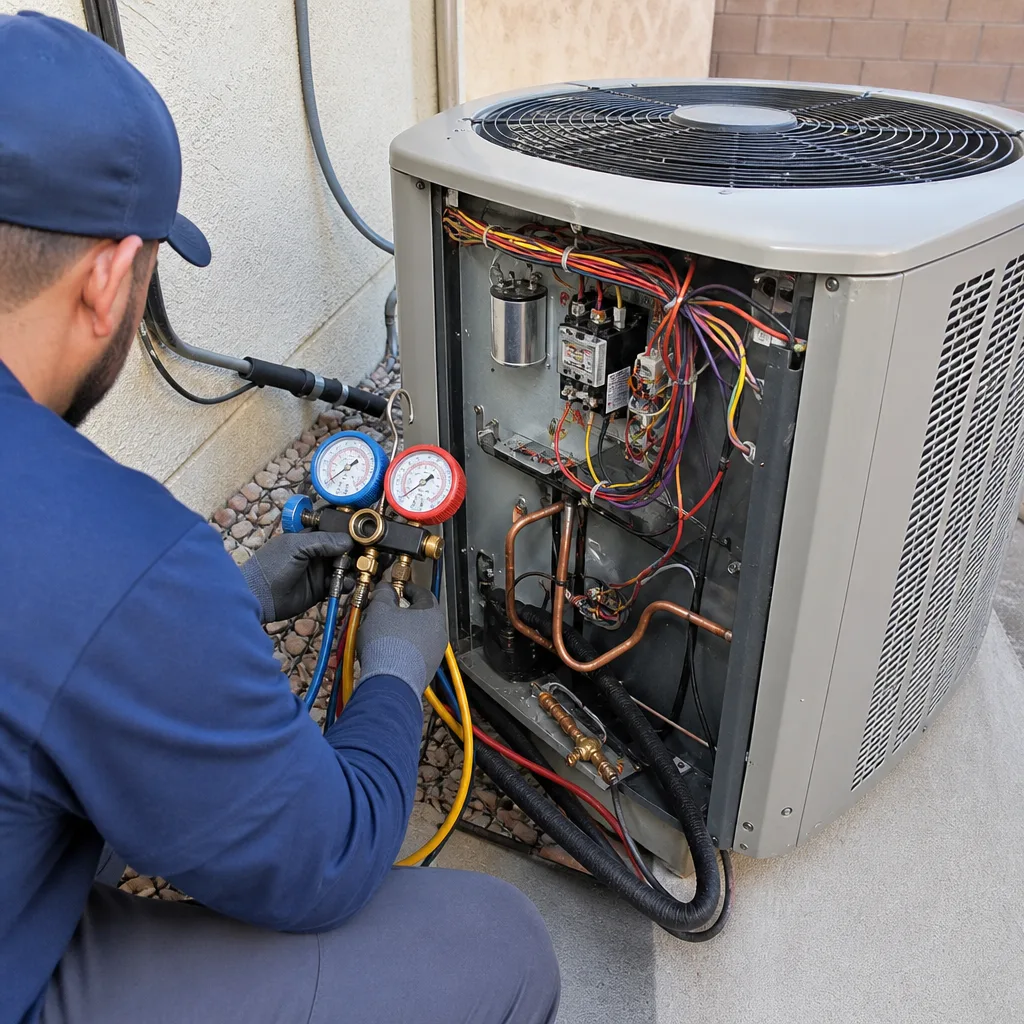
In our experience across Henderson, we see the same pattern every summer. A homeowner notices the AC isn’t cooling well. A neighbor or a YouTube video mentions “just adding some Freon.” They buy a can of refrigerant with a cheap gauge from an auto parts store, hook it to the low-side port, and overcharge the system. The compressor slugs liquid refrigerant, the valves fail, and a $300 leak repair becomes a $2,800 compressor replacement. The refrigerant line is not a gray area. It’s the line.
The Task-by-Task Table: DIY, Gray Area, or Licensed Only
Here’s the definitive breakdown. We’ve sorted every common HVAC task into three columns: legal and practical DIY, legal but skill-dependent DIY, and requires EPA 608 certification or a Nevada C-21 license. No ambiguity.
- Legal and practical DIY: Air filter replacement, condensate drain line flushing or vacuuming, visible coil fin straightening where accessible, thermostat battery replacement, thermostat recalibration or programming, blowing out the outdoor condenser fins with a garden hose and coil cleaner, clearing debris and vegetation around the outdoor unit, cleaning the condensate pump reservoir, replacing the blower motor’s return-air filter media, tightening loose electrical connections visible at the disconnect box when the power is verified off, lubricating accessible fan motor ports where present, checking and sealing duct register gaps
- Legal but skill-dependent DIY: Capacitor testing and replacement using a multimeter and proper discharge procedure, contactor inspection and replacement, hard-start kit installation, condensate pump replacement, thermostat full replacement with common-wire verification, fuse replacement at the disconnect, blower motor removal for cleaning where access allows, UV lamp bulb replacement, zoning damper actuator check and replacement, drain pan inspection and rust treatment
- Requires EPA 608 certification or a Nevada C-21 license: Adding or removing any refrigerant, leak detection or repair using gauges, replacement of any component in the sealed refrigeration system (compressor, evaporator coil, condenser coil, reversing valve, metering device, filter-drier, line set), brazing or soldering of copper refrigerant lines, natural gas or propane line work on a furnace, gas valve replacement, heat exchanger replacement, any electrical work involving the main electrical panel beyond the dedicated HVAC disconnect, ductwork installation or modification in designated HVAC zones under Clark County building code
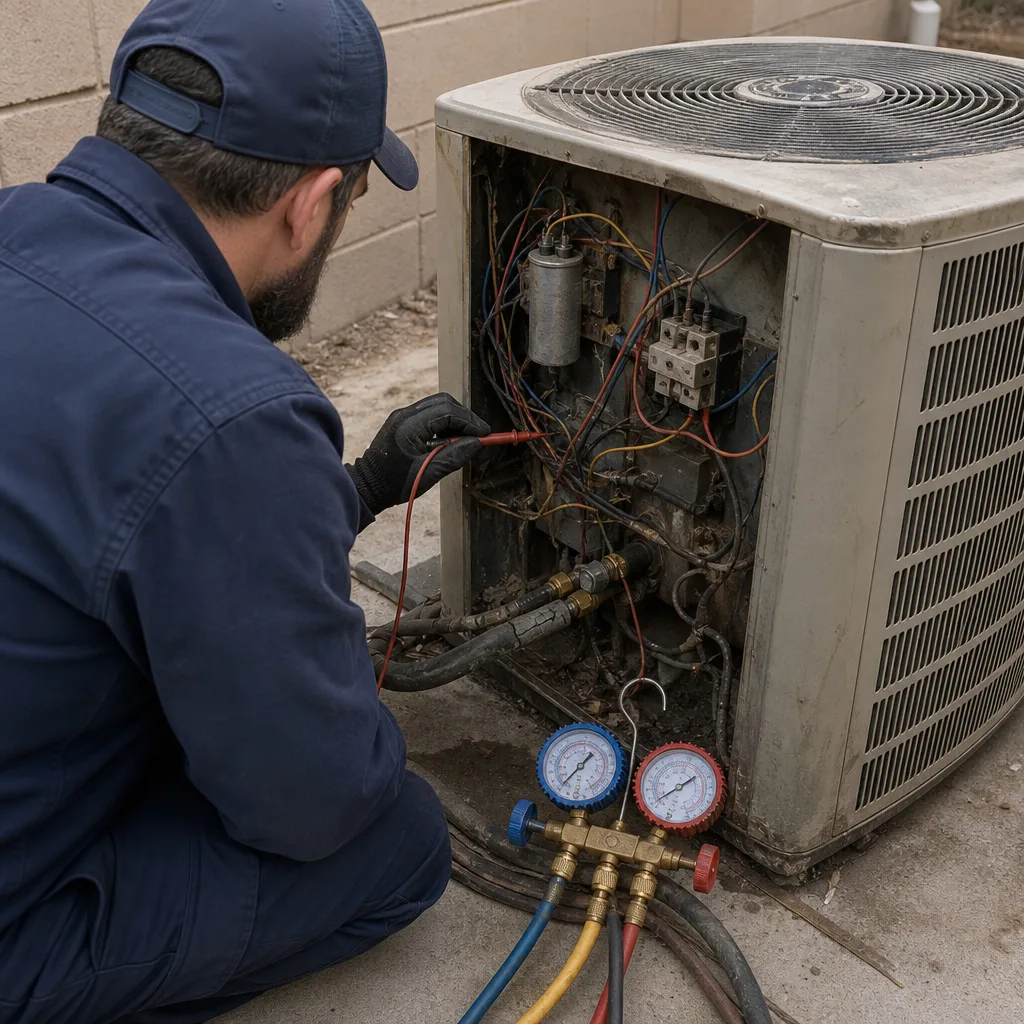
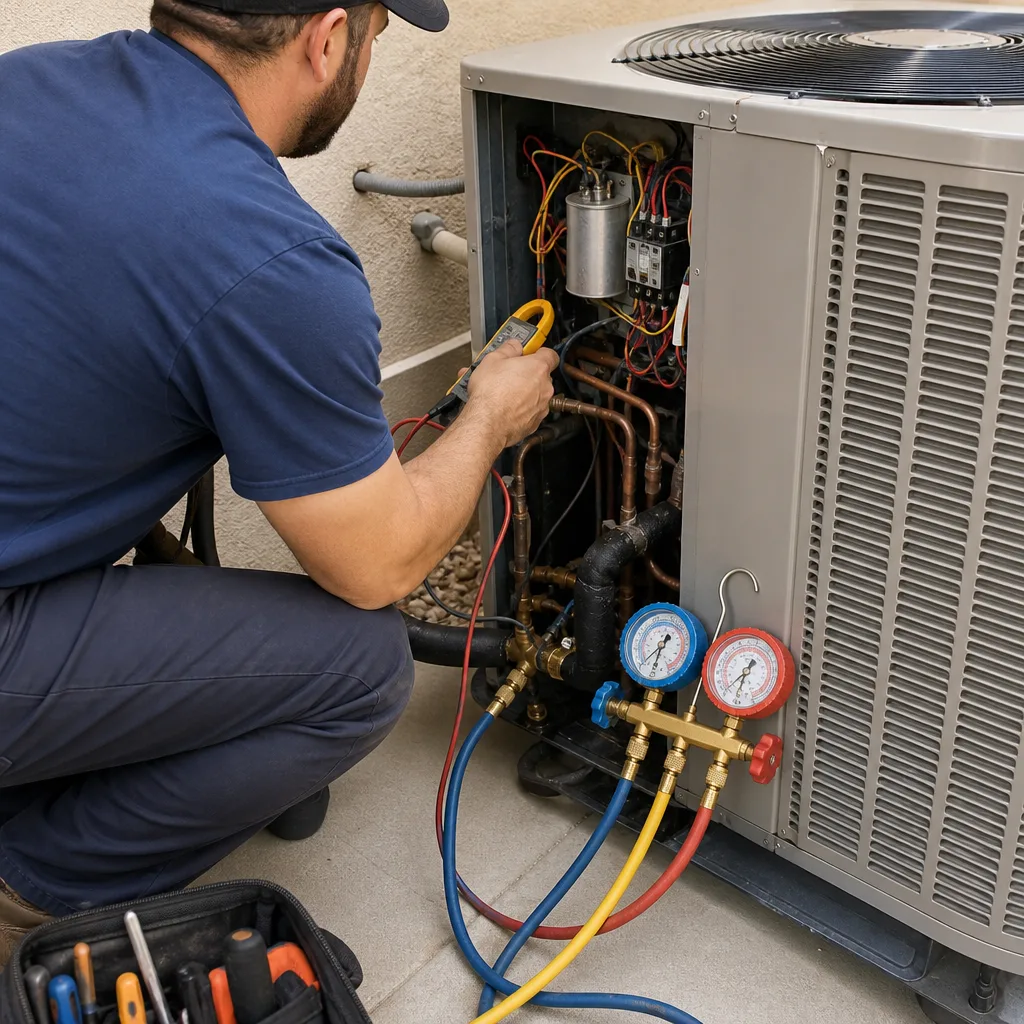
Here’s what surprises most Henderson homeowners: a capacitor sits on the gray-area line, and we’re deliberately putting it there. It’s legal to replace your own capacitor in Nevada. It’s also the single most misdiagnosed part in residential HVAC. A capacitor that tests fine with a basic multimeter in the driveway can fail under load when the compressor kicks on. Replace the wrong capacitor, and you haven’t fixed anything. Worse, a capacitor can hold a charge strong enough to stop a heart. We’ve seen homeowners shocked by capacitors they were sure were discharged. If you’re not comfortable with lockout-tagout discipline around that disconnect box, don’t open the panel.
What Carrier, Trane, and Lennox Actually Say About DIY Work
Your equipment warranty matters more in Henderson than in most markets because we run these systems hard. A typical Henderson AC compressor logs more annual runtime than the same unit in San Diego or Portland. When you need that warranty, the language matters. Here’s what the three major manufacturers actually state, quoted directly from their published warranty documents:
Carrier: “This warranty does not cover damage or repairs required as a consequence of… servicing by anyone other than a qualified installer or contractor.” Carrier’s standard limited warranty also excludes “incorrect electrical current, voltage, or supply,” and “modification, alteration, or adjustment of the product by anyone other than a qualified contractor.” That last clause has buried many a DIY capacitor job when the resulting failure landed on a Carrier warranty claim.
Trane: Trane’s base limited warranty states that coverage applies only when “the unit is installed, operated, and maintained in accordance with the manufacturer’s instructions” and that “failure to maintain the equipment” voids coverage. More specifically, Trane’s published limited warranty excludes “labor, service, or repairs performed by persons other than qualified service technicians.” The word “qualified” is doing real work there. In Nevada, a qualified technician for refrigeration work means EPA 608 certification at minimum, and for installation or modification work, a C-21 license.
Lennox: Lennox’s standard limited warranty includes this exclusion: “This warranty does not cover… defects, damage, or repairs caused by improper installation, application, service, or maintenance by a party other than a licensed HVAC contractor.” Lennox doesn’t use “qualified.” They use “licensed.” In Clark County, that means a C-21 contractor’s license. A homeowner who replaces their own compressor and then files a Lennox warranty claim when the replacement fails immediately has zero standing.
The practical takeaway for Henderson homeowners: if you do work inside the sealed system, or the manufacturer can plausibly argue that your modification caused a downstream failure, you’ve voided the remainder of your compressor and coil warranty. Not the whole unit’s warranty necessarily, but the components your work touched and anything that failed as a consequence. On a 2022 Trane XV18 with a 12-year compressor warranty, that’s a protection worth protecting.
Nevada C-21 Licensing and EPA Section 608: The Legal Boundary
Nevada requires a C-21 license from the Nevada State Contractors Board for any person or company performing HVAC work as a contractor. Receiving payment for HVAC installation, repair, or maintenance without a C-21 is a misdemeanor, and repeat offenses escalate. A homeowner working on their own home isn’t typically required to hold a C-21, but the moment you hire an unlicensed person because “his rates are better,” you’re hiring someone operating illegally in Clark County, and your equipment warranty protection often dies with that decision.
Federal law adds the second layer. The Clean Air Act, Section 608, requires EPA certification for anyone who handles refrigerant. That means opening a system, recovering refrigerant, adding refrigerant, or disposing of refrigerant-bearing equipment. The fines are not hypothetical. EPA can assess up to $44,539 per day, per violation. A homeowner buying a can of R-410A from an online seller and adding it to their system without certification is in violation, plain and simple. The seller is too, by the way, which is why legitimate supply houses in Henderson will not sell refrigerant to anyone without a 608 card.
We mention this not to scare homeowners away from reasonable DIY, but because Henderson’s housing stock includes a lot of 15-to-25-year-old systems nearing the end of their refrigerant lifecycle. Those R-22 systems from the early 2000s? R-22 production ended in 2020. What’s left on the market is recovered and recycled, expensive, and strictly controlled. A homeowner with an old R-22 system who’s tempted to “just top it off” is looking at a decision with legal, environmental, and financial weight. The honest conversation is usually about replacement, not recharge.
The Cost Cascade: How a $14 Capacitor Becomes an $1,800 Compressor
Henderson’s climate punishes deferred maintenance harder than almost any market in the country. Here’s the sequence we see every summer, and it’s worth reading slowly because it will save someone reading this guide a lot of money. The capacitor on your outdoor condenser is a $14 to $45 part depending on brand and specs. It gives the compressor and fan motor the starting voltage they need to kick on. When a capacitor weakens, the compressor may still start, but it draws more current than designed. The windings heat up. Over weeks, the motor insulation degrades. If the capacitor fails entirely, the compressor may not start at all, or worse, it may start and run with the fan motor stalled, overheating the whole system.
Now run that through a Henderson June. Ambient temperature in your attic is 130 degrees. Your AC is running 10 to 14 hours a day. That marginal capacitor fails on a Tuesday. The system shuts down. By Wednesday, the house is 88 degrees. You call around, and every reputable HVAC company in Henderson is booked 3 to 5 days out because 30,000 other people just had the same failure. By the time a tech arrives, the house has been hot for a week, your food’s been spoiled once, and you’ve spent two nights in a hotel or on a friend’s couch. The tech diagnoses the capacitor, but by now the compressor has been heat-soaking in a 140-degree environment without refrigerant circulation for a week. The oil in the compressor sump has degraded. A month later, the compressor fails mechanically. Now you’re not buying a capacitor. You’re buying a compressor, a contactor, a filter-drier, a flush kit, and 4 to 6 hours of labor. An $1,800 to $2,800 job. All preventable with a $14 part changed before the failure cascade began.
This isn’t fear-mongering. It’s the single most common cost trajectory we see in this market. The DIY lesson here isn’t “never touch your capacitor.” It’s “test your capacitor in April, before the first heat wave, and replace it that same day if it’s reading even 10 percent below rated microfarads.” A $50 multimeter with a capacitance setting and a careful YouTube video from an actual licensed tech will save you from being that homeowner in August. Or call us in April. The math works either way.
What Henderson Homeowners Can Safely DIY: Tools, Steps, and Real Limits
Henderson’s hard water and dusty air mean two maintenance tasks matter more here than they would in most markets: condensate line maintenance and coil cleaning. Here’s how to do both properly, plus the two other tasks that genuinely extend equipment life.
1. Condensate line flushing (monthly in summer)
Your AC pulls gallons of moisture out of Henderson’s desert air every day. That water drains through a PVC line that can clog with algae and mineral scale. When it clogs, water backs up into the secondary drain pan, and if that pan’s float switch fails, you have water damage in your ceiling. Here’s the right way: locate the condensate drain line exterior exit point near your outdoor unit. Attach a wet-dry vac to the line and pull suction for 30 seconds. Then pour a cup of white vinegar into the drain line’s cleanout T or the drain pan opening. Vinegar kills the algae without damaging the PVC. Do this monthly from May through October in Henderson, and you’ll prevent the most common DIY-preventable failure in our climate.
2. Coil fin straightening (twice yearly)
The fins on your outdoor condenser are thin aluminum strips that shed heat. They bend easily, and bent fins reduce airflow, which drives up compressor pressure and shortens equipment life. You can buy a fin comb, a plastic or metal tool with teeth spaced to match your unit’s fins per inch, for under $20 at most HVAC supply counters or online. Straighten bent fins gently, working top to bottom, one section at a time. Don’t force the comb deeper than the fin bend. Applying too much pressure folds the fins flat and makes things worse. Open to all nine major brands we service. Carrier, Trane, Lennox, Goodman, Rheem, York, Daikin, Bryant, and American Standard all use similar fin geometry, so one comb typically works across brands.
3. Filter media selection (not just replacement)
Most Henderson homes use a 1-inch or 4-inch filter in a return grille or at the air handler. The DYI decision isn’t just when to change it. It’s what to buy. Cheaper isn’t better. A fiberglass filter with a MERV rating under 4 catches almost nothing and lets dust coat your evaporator coil and blower wheel. A MERV 13 filter can restrict airflow enough to increase static pressure, reduce cooling capacity, and stress the blower motor, especially on older systems not designed for that media. For most Henderson homes, MERV 8 to MERV 11 is the practical range. Change it every 30 to 60 days during summer months when the system runs constantly, every 90 days in winter. If you have pets or live near a construction site in a developing part of town like Inspirada or Cadence, change monthly.
4. Thermostat calibration and placement
If your thermostat sits in direct afternoon sun from a west-facing window, or on a wall shared with a hot garage, it reads high and over-cools the house. Before you call us about a system that “runs all the time,” check the thermostat’s location and clean its internal sensor. Pop the cover off, use a soft brush or canned air to remove dust from the sensor, and verify the level with a small bubble level. A thermostat tilted even a few degrees can skew the mercury or electronic sensor. In a Henderson summer, that skew can mean the difference between a 74-degree house and a 78-degree house with the same system runtime.
How to Use a Professional Diagnosis Strategically
Most Henderson homeowners think of a professional HVAC visit as an all-or-nothing proposition, but our more guides & resources can help you find a smarter approach. Either the tech fixes everything, or the homeowner tries to fix everything. There’s a smarter middle path, and it’s one of the most underused strategies in residential HVAC.
Here’s how it works. You schedule a diagnostic visit with a reputable company. You pay the service call fee. You ask the technician to document, in writing, the exact condition of every major component: compressor amp draw, capacitor microfarad readings, contactor pitting, refrigerant pressures and temperature split, condenser coil condition, evaporator coil condition, blower motor amp draw, duct static pressure, and drain line condition. A good tech will document all of this anyway. A great tech will explain what each number means and what’s likely to fail in the next 12 months.
Now you have a written map of your system. And here’s the strategic part: you can defer the non-urgent items and DIY the ones that fall on your side of the line. If the tech notes that your capacitor is reading 35 out of 40 microfarads, you can decide to replace it yourself that weekend for $30, or you can have the tech do it while they’re there. If the tech notes a slow refrigerant leak of 1 pound per year, that’s not a DIY job, but it’s also not urgent in April. You can budget for a leak search in September after the worst of the season passes. Armed with the written diagnosis, you’re making informed decisions instead of reactive ones.
Ask the technician to note the exact model and serial number of your outdoor unit, indoor coil, and furnace. Henderson’s climate ages equipment fast, and knowing your equipment’s exact age and warranty status changes the repair-versus-replace math dramatically. We do this on every diagnostic visit at Dalton Heating & Air, and it’s a service that costs you nothing beyond the standard visit.
Why Henderson’s Climate Makes DIY Mistakes More Expensive
Henderson sits in the Mojave Desert. We get 300-plus days of sunshine a year, summer highs routinely above 105, and attic temperatures that hit 140 degrees. Your AC isn’t a comfort appliance here. During a June heat wave, it’s the difference between a livable house and a medical risk. The city’s elevation ranges from roughly 1,500 to 2,500 feet, and the combination of altitude and aridity means low humidity, which actually helps evaporative cooling but means your compressor runs hotter because there’s less ambient moisture to help shed heat.
This climate changes the risk-reward math on DIY decisions. In a mild coastal climate, a failed DIY repair means an uncomfortable afternoon. In Henderson in July, that same failure means your house hits 90 degrees in a day, your pets are panting, your medications are at risk, and you’re paying peak-season emergency rates. The cost of the DIY mistake isn’t just the repair. It’s the hotel room, the spoiled food, the missed work, and the body’s stress response. We’re not trying to scare you out of reasonable maintenance. We’re asking you to respect the environment you live in and make maintenance decisions in April and November that keep the system alive through the months when it matters most.
Common Mistakes to Avoid
- Adding refrigerant from a store-bought can. This is the big one. It’s a federal violation, it voids your warranty, and overcharging is the fastest way to destroy a compressor. If you’re low on charge, you have a leak. Leaks need a pro.
- Replacing a capacitor without discharging it first. A capacitor can hold a lethal charge even with the disconnect pulled. If you don’t know how to safely discharge a capacitor with a resistor or insulated screwdriver, don’t open the panel. This isn’t a YouTube tutorial situation. Electrical work near a storing capacitor is genuinely dangerous.
- Using the wrong filter for the sake of “better air quality.” MERV 13 filters on an old system restrict airflow and can cause the evaporator coil to freeze in Henderson’s dry heat when airflow drops too low. Match the filter to the system, not the marketing.
- Ignoring the condensate line until the ceiling shows a water stain. In Henderson’s hard water, these lines clog faster than homeowners expect. A monthly vinegar flush costs $3 and fifteen minutes. A ceiling repair costs hundreds and usually involves mold remediation.
- Hiring a “handyman” for refrigerant or gas work. A handyman isn’t licensed for HVAC work in Nevada, and if they cause a fire, a refrigerant leak, or a carbon monoxide incident, your homeowner’s insurance may not cover the damage because the work was performed by an unlicensed contractor. This applies to furnace repair, not just AC work.
- Deferring a $200 repair until it’s a $2,000 replacement. Henderson’s heat cycle punishes delay. The capacitor that’s weak but working in May is the compressor killer by August. The blower motor that squeaks on startup is the heat exchanger crack risk by December. When a diagnostic points to a specific failing part, replace it that season.
- Buying a condenser unit online and expecting it to work with your existing coil. Mismatched indoor and outdoor coils kill efficiency, void the manufacturer’s warranty, and create refrigerant charging nightmares. Equipment selection is not a DIY task, period.
See the difference
 Before
 After
After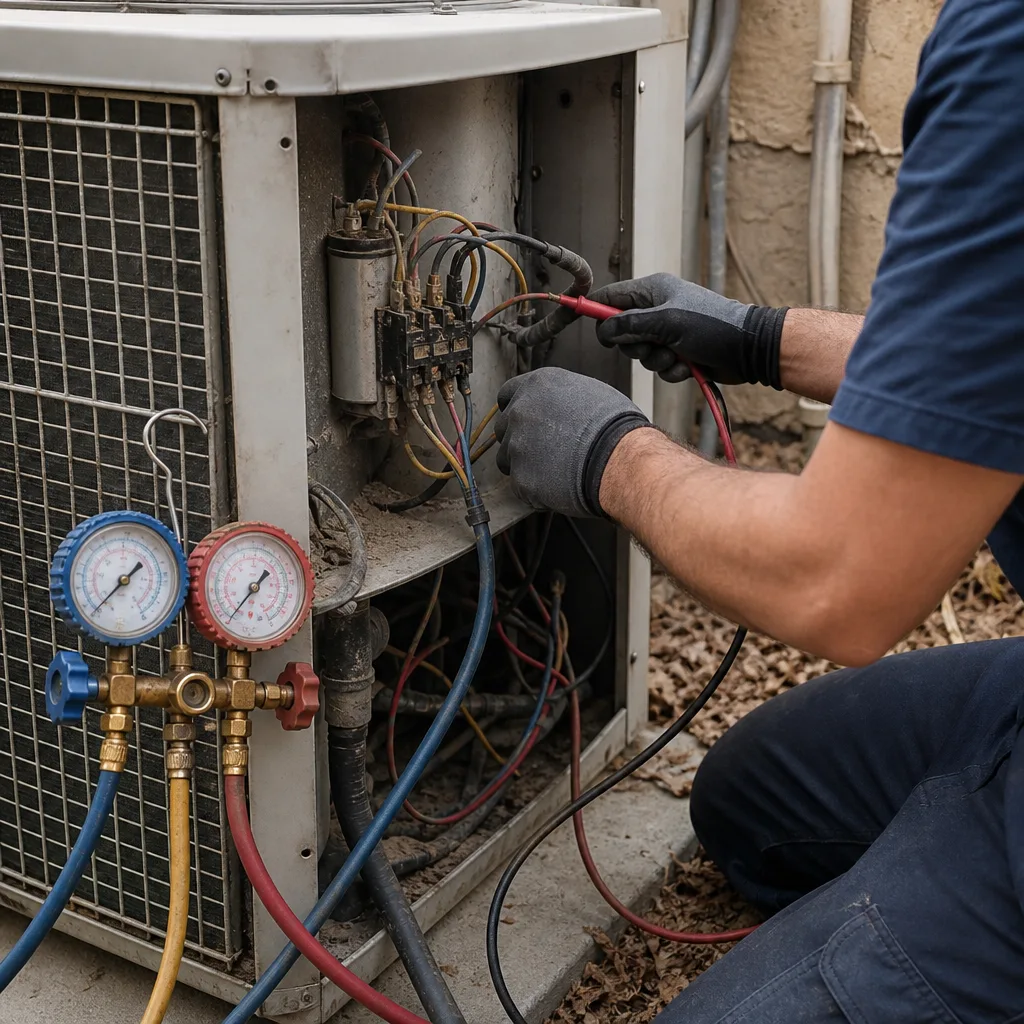 Before
 After
After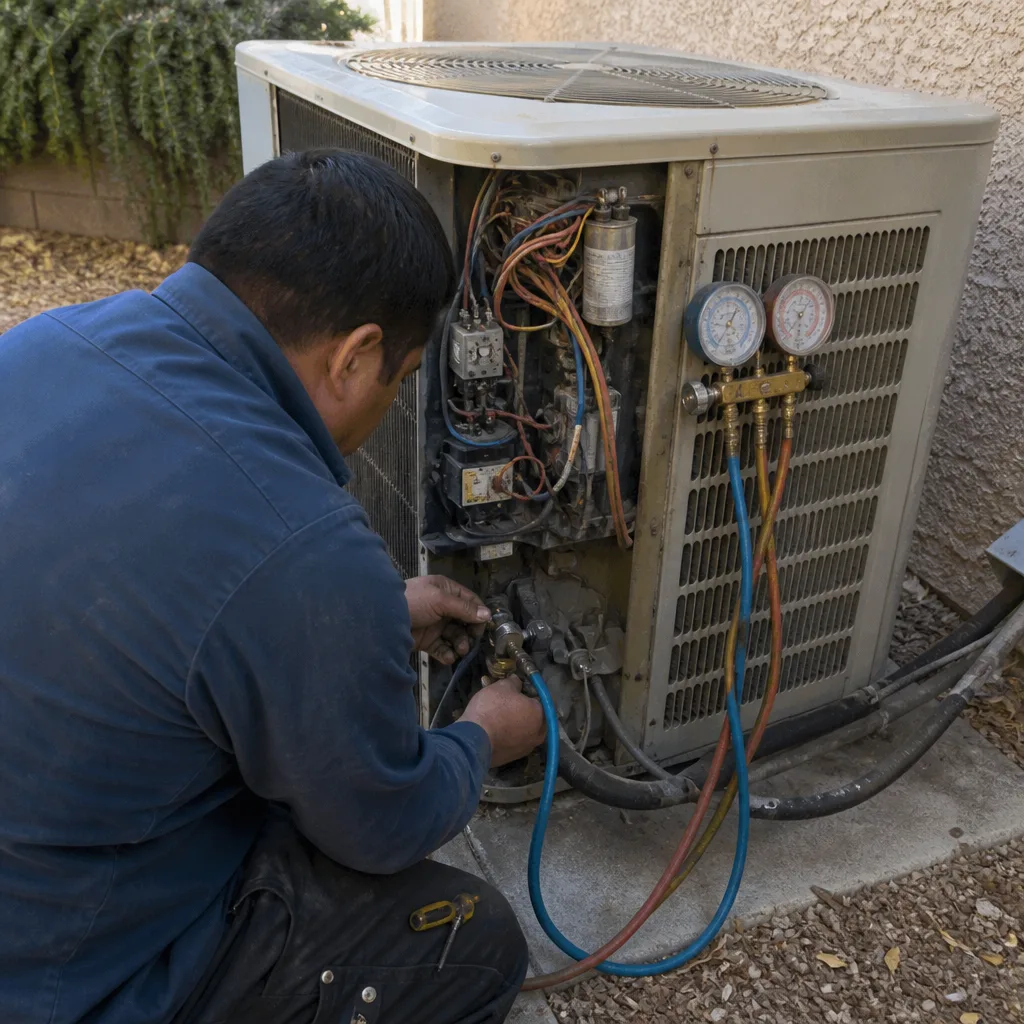 Before
 After
AfterWhen to Call a Professional
If any of these describe your situation, stop reading and pick up the phone: your system is blowing warm air in the middle of a Henderson summer, you smell burning or see sparking from the disconnect, your furnace is making a banging sound or you smell natural gas, you’ve noticed ice forming on the evaporator coil or the refrigerant lines, your condensate pan is overflowing into the ceiling, or your system is running constantly and not holding temperature. These are not DIY diagnostic situations. They’re emergencies or near-emergencies. Dalton Heating & Air Henderson offers free estimates in Henderson, and our techs document every diagnostic in writing before any work begins. Call (775) 593-7060 for an honest assessment of whether that repair is worth doing.
Frequently Asked Questions
Yes, a homeowner can legally replace their own capacitor in Nevada, provided they’re working on their own primary residence and not doing work for hire. The practical caveat is that capacitors store dangerous voltage even with the power off, and if you’re not comfortable discharging one safely, this is a $30 part worth paying a professional to handle.
Yes. Federal law under Section 608 of the Clean Air Act requires EPA 608 certification for anyone who handles refrigerant, including adding it to a residential system. Homeowners without this certification are in violation even if they own the unit. Fines can reach $44,539 per day, and it’s also how you void your compressor warranty.
The most common DIY mistake we see in Henderson is overcharging a system with aftermarket refrigerant because the homeowner assumed low refrigerant was the problem without confirming a leak. Overcharging damages compressors, and the underlying leak goes unfixed, meaning the problem repeats. A proper diagnosis with a leak check costs less than a compressor replacement.
In Henderson, a standard diagnostic visit typically costs between $75 and $150 depending on the company and the season, with most reputable companies including that fee toward the cost of any repair you approve. Some companies offer free estimates on replacement jobs but charge for diagnostic labor, which is fair because a quality diagnostic takes real time and expertise.
Only partially. The compressor, coil, and sealed system portions of the warranty are voided if you open the refrigerant circuit or if an unlicensed person modifies the system. Replacing a thermostat or air filter won’t affect your warranty, but any work inside the sealed system or gas valve assembly almost certainly will.
In Henderson’s dusty, high-use climate, every 30 to 60 days during the summer and every 90 days in winter is the practical interval. Homes with pets, new construction nearby, or smokers should lean toward monthly changes. A dirty filter is the single most common cause of reduced cooling capacity in their market.
The Bottom Line
Draw the line at the refrigerant. Everything above it, the filters, the fins, the drains, the thermostat, is reasonable DIY work that will save you money and extend your equipment’s life if you do it correctly and carefully. Everything below it, the sealed system, the refrigerant, the gas line, the main electrical panel, belongs to licensed professionals who carry EPA certification and Nevada C-21 licenses, not because the work is conceptually hard, but because the costs of getting it wrong are enormous and the legal exposure is real. Henderson’s climate doesn’t forgive maintenance neglect, so the smartest homeowner strategy is simple: do the DIY work that’s truly DIY, schedule a professional diagnostic every spring, and know exactly which side of the line any given task sits on. When you need the diagnostic, or the repair, or the honest conversation about whether to fix or replace, we’re here. Dalton Heating & Air Henderson has been serving this market since 2003, and we’re the company homeowners call when they’re done with no-shows and door-price swings. For AC Repair in Henderson, Heat Pump Installation in Henderson, or Furnace Repair in Henderson, call (775) 593-7060 for a free estimate and a written price before any work begins.
Written by Marco Benitez, Owner at Dalton Heating & Air Henderson, serving Henderson since 2003.